2026-11-03
Aluminum Door Handing: How to Specify Opening Direction in an RFQ
Avoid ambiguous left-hand and right-hand notes. Use a labelled plan, opening arc and revision record to clarify an aluminum door enquiry before hardware approval.
For an aluminum door enquiry, send a labelled plan showing the viewing side, hinge position and opening arc for every door ID. Ask the supplier to confirm its handing convention on the same drawing before you approve hardware or production. A note that says only “left hand” can leave the reference view unclear.
Start with the door ID and the view
Give each opening a stable reference, such as D-01, and use that reference on the floor plan, door schedule, quotation and approval drawing. Label the rooms or spaces on both sides. On an exterior opening, mark inside and outside; for an internal door, identify the corridor and room rather than assuming everyone uses the same reference side.
Add an arrow identifying the direction from which the elevation is viewed. A photograph may help explain the surrounding space, but it should accompany a marked drawing. Do not ask the supplier to infer a hinge position from an unlabelled product rendering.
Draw the swing before choosing the abbreviation
Show the hinge or pivot location and the opening arc in plan. State whether the leaf opens into the room or toward the adjoining space. Keep the written description and drawing together so they can be checked against one another.
Hardware terminology deserves particular care. Schlage explains that its method for selecting handed hardware differs from handing used for carpentry and that some lever products require a specified hand. This is a reason to request the selected hardware supplier's own convention, not to assume a universal LH or RH definition. Do not use a generic online diagram as the final approval for an unfamiliar hardware package.
For a paired opening, identify the leaf intended for normal access and ask the supplier to show the locking and operating arrangement. Mark any required operating sequence on the approved drawing. This checklist does not establish the emergency exit, accessibility or other regulatory requirements for a project; those must be set by the responsible designer for the location.
Check the surrounding space
Include nearby walls, furniture, steps, other doors and the intended circulation route on the plan. Ask the designer to review the complete opening arrangement and required clearances. A nominal frame dimension should not be used as a substitute for a confirmed clear opening dimension.
If an opening changes from inward to outward operation during design, return the revised plan to the supplier. Ask whether the change affects the proposed frame and sash arrangement, hinges, lock, handle, closer, threshold or installation details. Do not assume every component can simply be reversed on site.
Connect the handing record to the supply scope
Buyers sourcing Aluminum Window & Door Profiles may be ordering aluminum profile extrusions, a component package or complete fabricated doors. State which scope is required. If fabrication is carried out by another party, agree who translates the opening schedule into machining and hardware instructions.
When comparing an Aluminum Profiles Manufacturer with a system supplier or fabricator, compare the responsibilities as well as the product description. CIMU describes its role as a window and door system provider supporting configuration and production coordination. The exact scope, available configuration and commitments need to be confirmed for the order.
CIMU's door catalogue is a starting point for comparing opening types. Keep the handing record for a swing door distinct from the panel travel and stacking plan needed for sliding or folding doors. The product family name alone does not specify the arrangement for a particular opening.
Use a small revision register
For each door, record the door ID, drawing number, revision, date and approval status. When a layout changes, identify the affected doors and send the revised schedule with the new drawing. Ask the supplier to acknowledge which revision its quote or production proposal uses.
An illustrative record might read: D-01; view from corridor; hinges shown on marked plan; leaf opens into room; hardware hand to be confirmed by supplier; drawing A-12 revision B; pending approval. This is a communication example, not an approved product specification.
Before approval, check these items together:
- Door ID, location, dimensions and quantity.
- Labelled reference side and elevation viewing arrow.
- Hinge position, opening arc and intended operating arrangement.
- Glass, finish, hardware and any project performance requirements.
- Frame, threshold and adjoining construction details.
- Supply and installation responsibilities.
- Drawing revision and the person responsible for approval.
Send a useful enquiry to CIMU
Send the project location, labelled plans, door schedule, sizes, quantities, glass and hardware needs, required performance evidence, supply scope and destination port. Identify unresolved decisions rather than filling gaps with assumptions. Use the Products link to review the catalogue, then choose Discuss your project below to submit your brief.
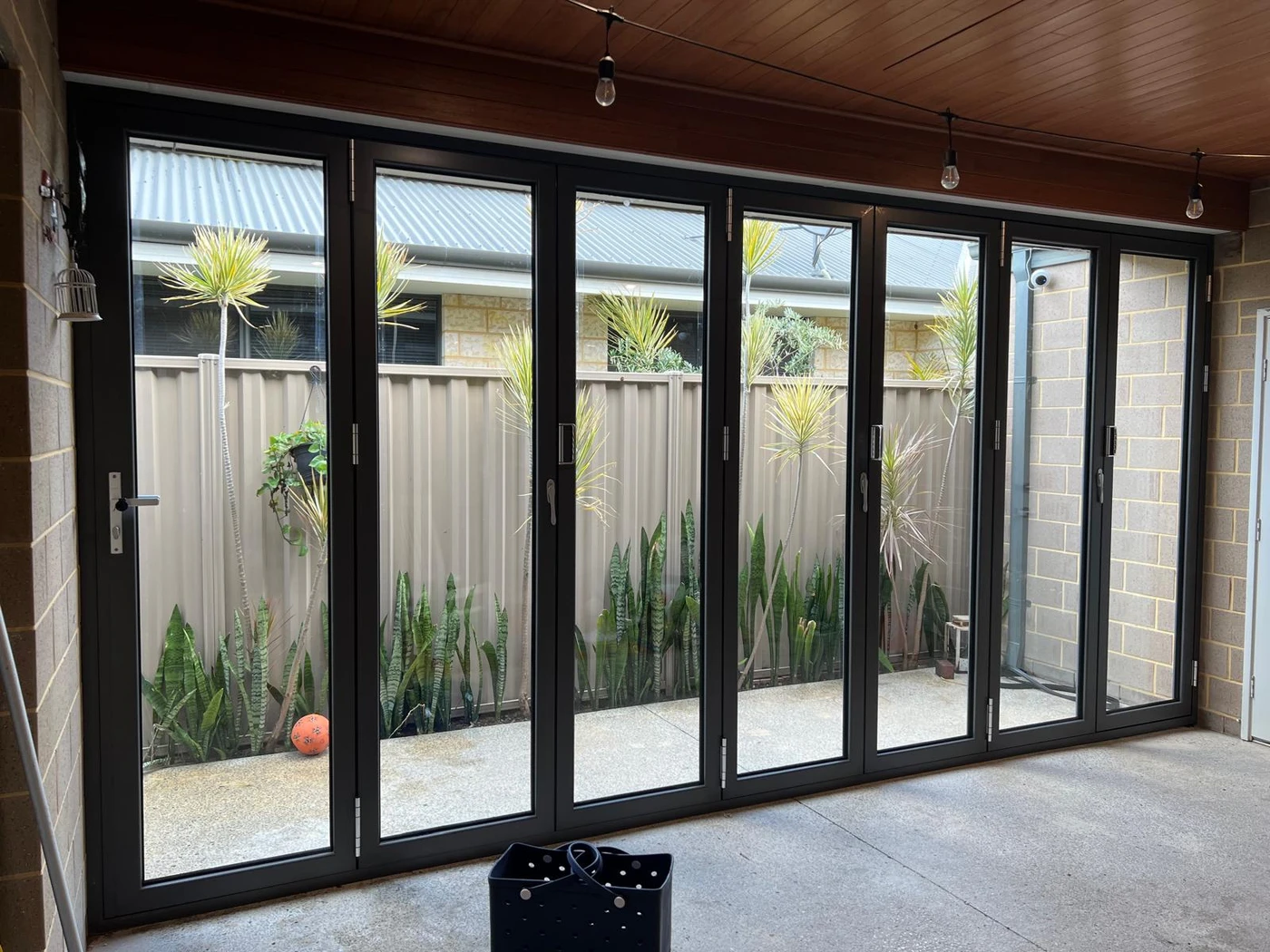
The accompanying photograph shows glazed folding doors from our supplied image library. It illustrates the need to identify the opening system and visible hardware. It does not establish a swing-door handing designation, product model, project location or performance rating. Confirm the operation on a labelled project drawing.
Sources and further reading
CIMU FAQ: https://cimualu.com/faq/
CIMU product catalogue: https://cimualu.com/products/
Schlage, How to understand lever and door handing: https://www.schlage.com/en/blog/product_updates/door-handing.html
Frequently asked questions
Is LH or RH enough to order a door?
Include the reference view and a labelled plan. Ask the supplier to confirm the convention used for the selected door and hardware.
Can the opening direction be changed after approval?
Request a review of the revised drawing and affected components. Do not assume the frame, hardware or installation can simply be reversed on site.
What information should an aluminum door RFQ include?
Send the location, door IDs, plans, dimensions, quantities, viewing side, swing arcs, glazing, finish, hardware needs, performance requirements, supply scope and destination port.